New city program to help BIPOC businesses succeed is floundering
on November 18, 2026
In August 2025, Kehinde “Empress” Koyejo opened Choc’late Mama Cookie Co. in a live-work space on Hubbard Street. She had little time to introduce her home-made p’nut butta soul, coco mama chip and raspberry bliss cookies to the neighborhood. Four months after opening, she was forced to close her business because she hadn’t secured the right county permit.
Koyejo didn’t know she needed a microenterprise permit from Alameda County in addition to receiving a business license from Emeryville. No one from the city had explained it to her, or helped her navigate the process.
“They literally would rather see my business go under than to address the real problem, which is that they really don’t have an infrastructure to support BIPOC businesses,” Koyejo said.
Since then, Emeryville has implemented a two-year trial program to help entrepreneurs like Koyejo, who is Nigerian-American, advance their aspirations. Introduced to the City Council last November, the BIPOC Small Business Support Pilot Program is intended to promote diversity in the city’s business community.
But in the past year, the program has fallen short of its goals.
‘I got to give the city a 10’
In a November 2025 presentation to City Council, city staff had laid out plans to visit 173 BIPOC-owned businesses and to aggregate small business resources to a single page on the city’s website within eight months of the program’s launch.
But 10 months later, in September, Niwonna Jones, who oversees the program, said she had contacted 75 businesses and had visited only about 18 of them. Jones prepared a survey for business owners that she hopes will steer the program’s spending, but the City Council has yet to determine the budget.
As for the city’s website, in its business page is a heading titled Business Resource Guide. Below the heading are the words “under development.”
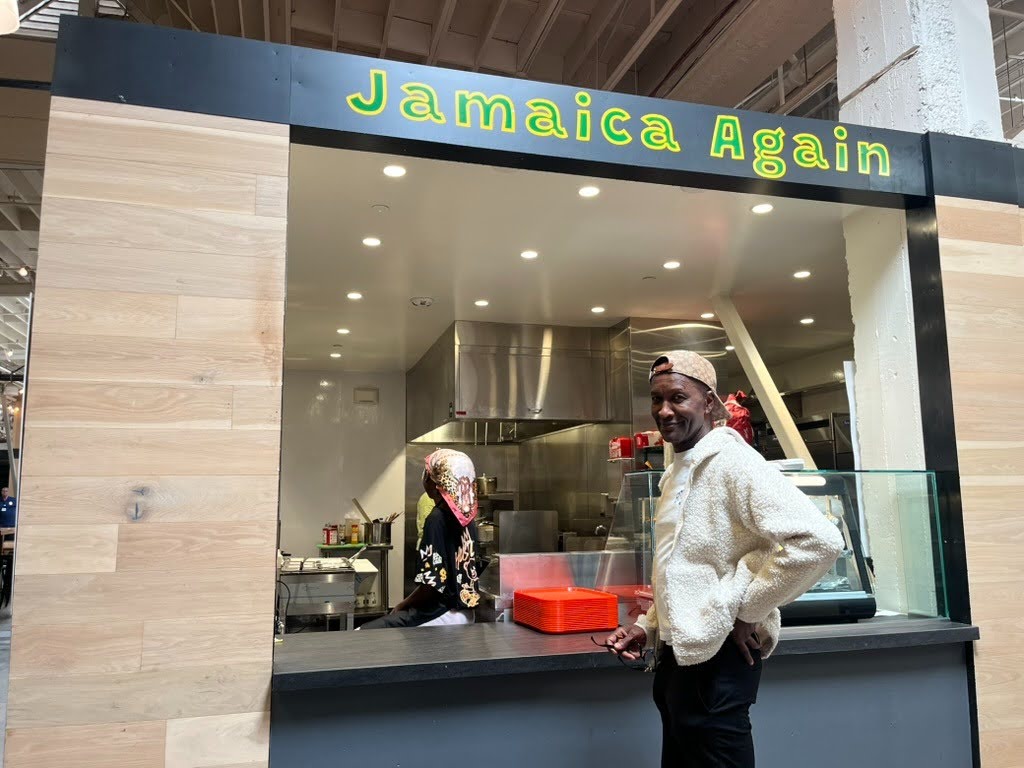
For those it has helped, Emeryville’s BIPOC program has been invaluable. Rashaun Simpson, a Black business owner, said the city fast-tracked public health and fire inspections so that he could open his Jamaica Again restaurant on schedule in the Emeryville Public Market in August. The vice mayor came to the grand opening, where Simpson introduced customers to classic Jamaican dishes like braised oxtail and jerk chicken. A few weeks later, city staff checked to see how things were going for the first-time business owner.
“I got to give the city a 10,” said Simpson. “I love them.”
Surveying business owners
Emeryville began to build the BIPOC small business program in 2024, after contracting Northeastern University to conduct a needs assessment. According to an article in Northeastern University’s newspaper, university students contacted 206 Emeryville business owners in 2025, conducting in-depth interviews with 16. The school reported that “many calls to look for interviewees resulted in unanswered voicemails.”
Northeastern suggested the city partner with culturally related businesses, dedicate more time to small business engagement, and follow up with study contacts.
When the findings were presented to the Emeryville Economic Development Advisory Committee in July 2025, “opinions diverged around whether enough information was obtained to design a program,” according to the meeting minutes.
Left out of the study were home-based businesses like Koyejo’s.
Jasmine Sozi, an organizer at Restore Oakland, a small-business advocacy nonprofit, called their exclusion a “disservice.” According to Sozi, home-based and nontraditional businesses can serve as entry points for those in marginalized communities who have historically been locked out of entrepreneurial pursuits.
“We really have to start taking seriously how people are trying to survive and build wealth for themselves and their families, … a lot of that being in non-traditional spaces, which are oftentimes home-based businesses,” Sozi said.
Around the same time as the Northeastern study, Restore Oakland conducted its own BIPOC small business survey, collecting responses from 120 Alameda County BIPOC small businesses, a portion of which were home-based. The survey identified affordability-related issues — namely operating costs and rent — as barriers.
High rents have put excessive financial pressure on business owners and have contributed to vacancy rates across the East Bay, reducing foot traffic to commercial areas. Sozi says policy changes, such as leveling fees on properties that are left unoccupied for long periods, can help fill units and possibly lower rents. Unlike Oakland, Emeryville does not have a vacancy tax for commercial properties.
Permitting also emerged as a source of dissatisfaction, especially among home-based business owners, who felt that none of the available licenses fit their business model.
Making grants available
Emeryville’s BIPOC small business support program does not recommend policy changes. Instead, the city is hoping to give these businesses a boost with event-based programs.
In September, Emeryville’s Economic Development Advisory Committee discussed providing grants of $5,000 to $25,000 for culturally significant celebrations that create economic activity. Eligible items for funding would include vendor infrastructure, performance fees, marketing and permits.
Events can be opportunities for businesses to introduce themselves to a wider audience, but the price to join is high. Jessikah Fechner, a Japanese-American business owner, has found that vending permits required to participate in markets and street fairs create an undue burden on her business.
Fechner operates a sourdough bakery, Who Let Her Bake, out of her Oakland kitchen. She sells loaves online and at markets, including the Makers Hive Market at Bay Street. Each time she participates in the market, she must obtain a $143 temporary food facility permit. For vendors selling non-prepackaged food, permits can stretch to over $300. Vendor booths also require insurance, tents and other overhead costs.
“You really have to be strategic … you can get yourself into a lot of debt before you even start selling,” Fechner said. If the city could offer grants for permits, she said, “that would be amazing.”
Emeryville City Clerk April Foran said the city is working on a grant program for vendors. Details like how much money the city would provide and how many vendors would be helped are still being determined. The grant would have to be approved by City Council.
(Top photo of Rashaun Simpson at his Jamaica Again restaurant, by Alessandra Rizzo)
In retail-heavy Emeryville, shoplifting has declined. But can you believe the numbers?
Emeryville Today welcomes comments from our readers, but we ask users to keep all discussion civil and on-topic. Comments post automatically without review from our staff, but we reserve the right to delete material that is libelous, a personal attack, or spam. We request that commenters consistently use the same login name. Comments from the same user posted under multiple aliases may be deleted. Emeryville Today assumes no liability for comments posted to the site and no endorsement is implied; commenters are solely responsible for their own content.